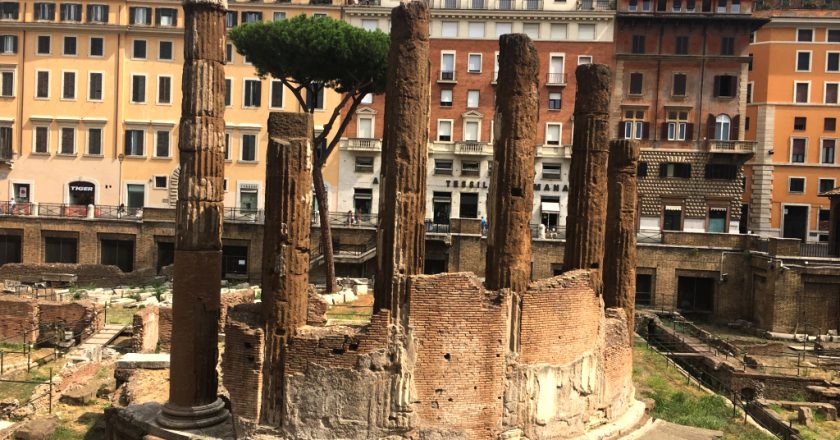
Rome is, without a doubt, one of our favourite cities. Romance, history, art, and fashion can be felt on every corner. Here, you can admire the magnificent legacy of the Renaissance and the Baroque, while also being captivated by the enduring heritage of the Roman Empire, all within the same cosmopolitan, dynamic, and vibrant city. The Eternal City is a destination to be enjoyed and appreciated at a leisurely pace, as it offers endless possibilities, each one more captivating than the last.
In an ambitious attempt to fit the very best of Rome into a limited amount of time, we have put together this itinerary for travellers who want to visit some of the city’s must-see landmarks during a short stay. We believe that three days are enough to discover some of Rome’s greatest charms, and certainly enough to leave you completely captivated by them all and eager to come back for more.
Travelling to Rome by Car

Our trips to the Italian capital have always been by car—one of the best ways to experience this magnificent country in every sense. Italy is full of delightful places, picture-perfect cities, and charming villages. One of our favourite routes is to arrive in Rome by driving through the whole of Tuscany, and then leave the city by following the coast all the way to Liguria. It is a journey of unforgettable beauty, and one we highly recommend to all travellers who enjoy life on the road.
Once in Rome, a great accommodation option is Hotel Suite Beccaria, mainly for two reasons: free parking is available nearby, and it is located in an excellent area if your plan is simply to wander the city’s streets.
Once we no longer have to worry about the car, all that remains is to enjoy the city. So, let’s begin our three-day tour of Rome… happy travels!
DAY ONE
We begin by heading to Vatican City, a visit that can easily take up most of the day. Before reaching our destination, however, there is one essential stop: Castel Sant’Angelo. After exploring the Vatican, we stroll along the banks of the Tiber River to Trastevere, one of the city’s most charming neighbourhoods. The perfect way to end the first day is by heading to the Janiculum Terrace, where you can enjoy a breathtaking panoramic view of Rome and admire the beauty of the Fontana dell’Acqua Paola.
Visit to Castel Sant’Angelo
Castel Sant’Angelo, also known as the Mausoleum of Hadrian, is an impressive building located opposite the Vaticanand overlooking the Tiber River. Construction began under Emperor Hadrian in AD 135, with the intention of creating a family mausoleum. It later served a military function, and since 1277 it has been connected to the Vatican by the Passetto, an 800-metre fortified corridor that has appeared in several films and novels, including the famous Angels & Demons by Dan Brown. Today, it offers one of the finest viewpoints in Rome.

A Morning in the Vatican
A place of overwhelming beauty and extraordinary richness, condensed into a small yet majestic space. This remarkable destination deserves a special mention, which is why we have dedicated an entire article to it, available to read at this link.

A Stroll Along the Tiber River
Pure romance. A walk along the Tiber River is one of those experiences that should not be missing from your itinerary when visiting Rome. It is Italy’s third-longest river and has been closely linked to the origins of the city, serving for centuries as Rome’s main route of communication. Today, you can cruise along its waters and discover a different perspective of the Italian capital, or simply wander along its banks and enjoy its charming scenery.

An Afternoon in Trastevere
It is one of Rome’s historic neighbourhoods and, without a doubt, one of our favourites. It is characterised by its unique architecture and charming cobbled streets, where it is always a pleasure to wander without a destination. The neighbourhood also offers one of the city’s best leisure scenes, with countless pubs, restaurants, and unique shops, making it one of Rome’s main tourist hubs.

Terrazza del Gianicolo
Rome has several viewpoints from which to admire the beauty of the city. For this itinerary, however, we have chosen the Janiculum Terrace. Located above the Trastevere district, it is one of the city’s best-known viewpoints. It can be reached by bus, but our recommendation is to walk up and enjoy the peaceful stroll that this area has to offer.

Fontana dell’Acqua Paola
Once at the Janiculum Terrace, we can also admire one of the city’s most spectacular fountains, the Fontana dell’Acqua Paola, also known as Il Fontanone (The Great Fountain).

DAY TWO
As we mentioned earlier, we chose to stay in a hotel very close to Piazza del Popolo, one of the city’s main hubs. Dominated by the Flaminio Obelisk, an Egyptian monument dedicated to Ramesses II, and framed by the churches of Santa Maria dei Miracoli and Santa Maria in Montesanto, this magnificent square marks the beginning of the city’s famous Trident: Via del Corso in the centre, Via del Babuino to the left, and Via di Ripetta to the right. These three wide avenues are lined with luxury boutiques, art galleries, magnificent buildings, and visitors from all over the world, forming the three main arteries of Rome.
For our second route, we will follow Via del Corso. Among the finest fashion brands, you will find one of Rome’s most famous shopping centres, the Galleria Alberto Sordi. Opposite it stands another of the city’s iconic landmarks, the Column of Marcus Aurelius. We then continue to Piazza Venezia, climb Capitoline Hill, and enjoy one of the best views of the Roman Forum. From there, a visit to the Colosseum is an absolute must. Before finishing our route through this magnificent part of the city, we make one final stop at the Mouth of Truth.
Colonna di Marco Aurelio
This column, distinguished by its striking spiral relief, stands in the centre of Piazza Colonna, directly opposite the historic Palazzo Chigi. It was built between AD 176 and 192 to commemorate the victories of the Roman Emperor Marcus Aurelius, and today it rises proudly in the heart of one of the main streets of the Italian capital.

Piazza Venezia
This is one of the busiest and most visited squares in Rome. Located at the foot of Capitoline Hill, it leads directly to the Roman Forum and the Colosseum. In this magnificent square, you will also find another of the city’s iconic landmarks: the Victor Emmanuel II Monument.

Colle Capitolino
For us, this is one of the most fascinating places in Rome. Located between the Roman Forum and the Campus Martius, it is the most famous of the Seven Hills of Rome and offers some of the finest views in the city. From here, you can admire one of the most impressive and important legacies of the Roman Empire: the Roman Forum.
It is also home to Piazza del Campidoglio, designed by Michelangelo, the Capitoline Museums, the Palazzo Senatorio, the Palazzo Nuovo, the replica of the Equestrian Statue of Marcus Aurelius, and the Capitoline Wolfsculpture, all of which can be reached via the famous Cordonata Staircase.

Foro Romano
Simply spectacular. From Capitoline Hill, you can admire the entire Roman Forum, once the urban heart of the Roman Empire, where daily life unfolded and where the markets, public institutions, and temples were located. The opportunity to admire this extraordinary historical legacy is truly priceless.

Colosseo
Perhaps one of the monuments that never fails to amaze us with its sheer grandeur is the Colosseum. By day or night, it always feels awe-inspiring and extraordinary. History tells us that its construction began during the reign of Emperor Vespasian, around AD 71. It is the largest Roman amphitheatre, where bloody spectacles were held to entertain the people. In 1980, it was declared a UNESCO World Heritage Site, and in 2007, it was named one of the New Seven Wonders of the Modern World. Without a doubt, it is a must-visit monument.

La Boca della Veritá
Another stop that we absolutely love. This is an enormous stone sculpture, measuring 1.75 metres in diameter, which pays tribute to the God of the Sea. According to legend, a man who doubted his wife’s fidelity brought her to this monument to test her honesty. The woman pretended to faint and was carried away by her lover. She then swore that she had only been with her husband and the man who had carried her, allowing her to tell the truth without revealing the affair. Today, it is common to see queues of tourists waiting to place their hand inside the Mouth of Truth and take the classic souvenir photograph.

Iglesia de Santa María in Cosmedin
The Bocca della Verità is set into one of the walls of the Church of Santa Maria in Cosmedin, which is also well worth a visit, as it is a church built in the 6th century on the remains of the Temple of Hercules. It is notable for its austere decoration and for the crypt beneath the altar, created in the 8th century to house the relics that Pope Adrian I brought from the catacombs.

DAY THREE
On our third day, we will begin from another of the city’s main thoroughfares, Via del Babuino. Passing luxury boutiques, beautiful churches, and elegant restaurants, we will arrive at Piazza di Spagna. From there, we will continue to the Trevi Fountain, a true icon of la dolce vita. Our route will also take us to the magnificent Pantheon. We will then continue wandering through the streets until we reach another of the city’s most spectacular landmarks, Piazza Navona. We will end our route by visiting a truly charming spot, Campo de’ Fiori.
Piazza di Spagna
Always bustling with people, Piazza di Spagna is one of the busiest and liveliest areas in Rome. Its famous Spanish Steps lead up to the Trinità dei Monti Terrace, from where you can admire the beautiful views over the city.
At the centre of the square stands the Fontana della Barcaccia, one of the many masterpieces by Pietro Bernini. Piazza di Spagna is one of the hearts of the city and the perfect place to sit on its steps and watch the dynamism and energy of Rome unfold.

Fontana di Trevi
And, of course, it is time for the moment everyone looks forward to when visiting Rome: throwing one or more coins into the Trevi Fountain. A must! The myth originated with the 1954 film Three Coins in the Fountain, directed by Jean Negulesco. It says that if you throw one coin, you will return to Rome; if you throw two coins, you will find love with an Italian; and if you throw three coins, you will marry the person you met.
If there is one thing Rome is famous for, it is its fountains. But if there is one that captivates visitors with its unique beauty and the setting in which it stands, it is the Trevi Fountain. It is the largest fountain in the city, measuring 20 metres wide and 26 metres high. The monumental fountain we admire today was designed by the architect Nicola Salviand completed by the architect Giuseppe Pannini in 1762. It is an iconic landmark, not least because of the legendary scene from La Dolce Vita, in which Marcello Mastroianni and Anita Ekberg share their unforgettable kiss in the fountain.

Panteón de Agripa
Our route would not be complete without a visit to the Pantheon of Agrippa, also known as the Pantheon of Rome. It is one of the most highly regarded and best-preserved architectural works in the Italian capital. Spectacular in its dimensions, it measures 43.30 metres in both diameter and height, with a dome larger than that of St Peter’s Basilica.
This monument was built in AD 126, during the reign of Emperor Hadrian, and takes its name from the fact that the original Pantheon of Agrippa once stood on the same site. It is well worth a visit to experience the remarkable sense of grandeur it conveys.

Plaza Navona
Piazza Navona is full of energy, rhythm, and art. It is one of the Romans’ favourite places to relax, thanks not only to its striking and captivating beauty but also to one of the most spectacular examples of Baroque art: the Fontana dei Quattro Fiumi (Fountain of the Four Rivers).
This magnificent work of art was created by the Italian sculptor, architect, and painter Gian Lorenzo Bernini in 1651. The fountain is composed of four statues, each representing one of four rivers: the Nile, the Danube, the Ganges, and the Río de la Plata. At its centre stands an obelisk from the Circus of Maxentius, rising 16 metres above the fountain.
It is truly a masterpiece that we never tire of visiting and admiring.

Campo dei Fiori
We bring our express tour of Rome to a close at Campo de’ Fiori. It takes its name from the fact that it was built on a field of flowers in 1456, commissioned by Pope Callixtus III. It is another of the city’s liveliest and most attractive squares.
During the day, it is home to a flower and food market, while in the evening it offers a wide range of entertainment for visitors, with its many terraces and pubs.

Rome, the Eternal City…
This brings our three-day tour of Rome to an end. Needless to say, this wonderful city deserves a lifetime—or more—to be truly appreciated. However, if you are looking for the perfect introduction, these are the places we believe should not be missing from your itinerary.
That said, our best recommendation is to let yourselves get lost in the city and enjoy it at a leisurely pace. Rome is a destination that deserves more than one visit.
Sources and Useful Links
Historical and Technical Information on Rome’s Monuments
Vatican City
Castel Sant’Angelo
Fontana di Trevi
Legend of the Bocca della Verità
The Colosseum in Rome
Church of Santa Maria in Cosmedin
IMAGES BY TRAVELLERSANDCO
You must be logged in to post a comment.