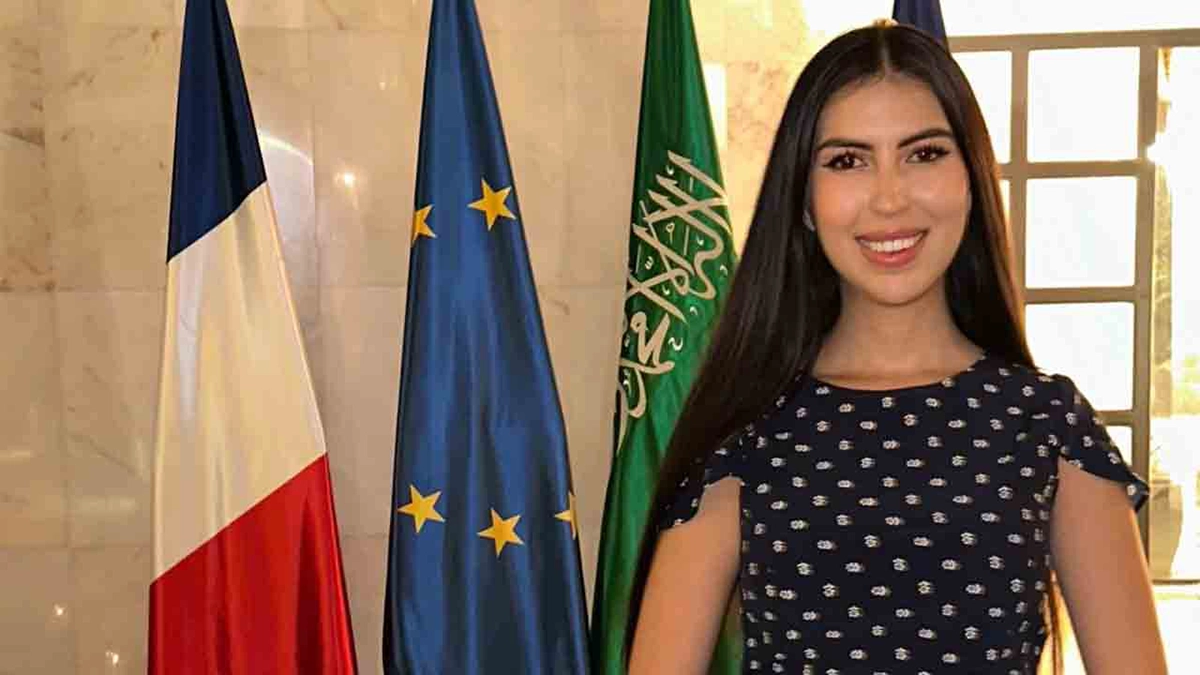

Cristina López Ortiz, the current Cultural Manager of the Alliance Française in Saudi Arabia, is a young woman from Mallorca who maintains a close connection with Barcelona, the city where she grew up and which she recognises as a benchmark for culture, history, and diversity.
With a multidisciplinary education and an outstanding academic career, Cristina López Ortiz studied law, although culture has always been part of her life.
Since childhood, she has felt drawn to history, art, and literature. Today, this background allows her to work in the cultural sector with a legal perspective, in-depth economic analysis, and experience that has enabled her to attain and consolidate her current position, leading one of the most important cultural and educational associations in the Middle East.
Cristina López Ortiz answers some of the key questions surrounding Saudi Arabia’s cultural landscape, the challenges and opportunities that art presents in the country, and her own experience as Cultural Manager of the Alliance Française.
What connection do you have with the city of Barcelona?
I had the immense privilege of studying at the Lycée Français de Barcelone, a school that instilled in me many values and a love of literature, art, and the French language. My father, Albert, played an important role in my cultural development, as he always encouraged me from childhood to appreciate local culture.
Catalan is a language that brings back beautiful memories. Whenever I can, I explain abroad the beauty of the other languages spoken in Spain, as it is a wonderful way of remembering our country’s cultural richness. For me, Barcelona is synonymous with diversity, something that can be seen in its cultural heritage. It is the city of Marina, described by Carlos Ruiz Zafón, but also the city of Gaudí and of Sant Jordi’s Day, both of which carry great symbolism because they demonstrate that tradition and modernity can be brought together.
What is the main role of the Alliance Française in Saudi Arabia?
The main role of the Alliance Française in Saudi Arabia is the teaching of French, but this is not its only function, as for several years it has also been one of the cultural operators contributing to the dissemination of French and European culture.
In cultural terms, what are its main missions?
The main cultural missions of the Alliance Française in Saudi Arabia are divided into three areas. First, there is a mission of cultural dissemination, which allows French artists to become known among local audiences, while also contributing to the development of various art forms.
We also have a mission of cooperation with Saudi artists and institutions, which enables genuine cultural exchange. In this way, a synergy is created between the cultures of both countries, synonymous with friendship and respect.
Finally, I can say that the Alliance Française enables constant exchange between Arab culture and French culture. There is genuine cultural interaction every day in our centres, whether through the French language or through our activities.
As a Western woman leading such an ambitious project within an institution as well established as the Alliance Française, what challenges do you face? What objectives have you set?
In a country where the cultural sector has undergone significant expansion in recent years, keeping up with new trends can be a challenge, as new projects and ideas are constantly being developed. One of the fundamental priorities for everyone working in Saudi Arabia’s cultural sector is to understand and align with Vision 2030, which allows us to collaborate more effectively with local artists and institutions in order to create enriching and innovative programming.
The Alliance Française is an institution recognised and identifiable for its diversity. How is this diversity experienced in Saudi Arabia? How do Francophone and Arab cultures enrich and influence one another through your institution?
Diversity is quite common in Saudi Arabia, as people of many nationalities can be found throughout the country. What is truly interesting about this diversity is the respect that exists among individuals. Saudis are extremely hospitable people who try to understand and offer the very best to those who visit or settle in the country. Francophone cultures and Arab culture primarily enrich one another through activities, events, and exchanges between people.
The Alliance Française plays an important role in this cultural exchange, as it enables interaction between the two languages, as well as the organisation of culinary and artistic activities. A good example is our cooking workshops, in which Saudi participants and people of other nationalities come to learn recipes from French cuisine while also expanding their French vocabulary.
And for you personally, what has your experience in Saudi Arabia meant? Tell us about Saudi Arabia’s artistic scene. What can we find there, and how can we contribute?
Personally, I find it a fascinating country where, in addition to the exceptional local hospitality, one can appreciate the language, cuisine, and art. Arabic in Saudi Arabia is more than a language; it is synonymous with poetry and literature. There are great opportunities for artists, and an increasing number of residencies are being developed to encourage the exchange of techniques and information between different cultures, with the aim of enriching the Saudi cultural scene.
One point I would particularly like to emphasise is that talent is highly valued, and that Saudi Arabia is a country where women and young people are greatly appreciated. It is a country in which female artists are widely recognised both locally and internationally. They are known for their extensive knowledge and involvement in a wide range of cultural fields, including music, fashion, the environment, and gastronomy, among many others.
You must be logged in to post a comment.